
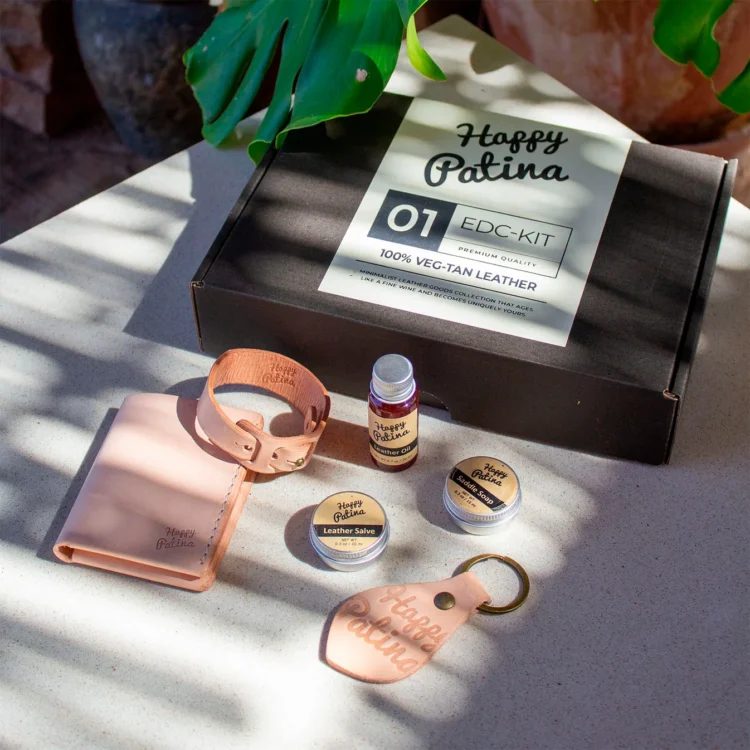
There’s a bifold wallet sitting on a desk in Barcelona that tells a story its owner never intended to write. The leather has darkened unevenly—lighter where fingers never touch, deeper brown where thumbs have gripped it thousands of times while pulling it from a back pocket. A faint rectangular outline marks where a train ticket from Prague sat for three weeks, pressed against the interior, its ink and oils slowly migrating into the hide. In one corner, a small cluster of scratches forms a constellation that appeared the night the wallet slipped from a coat pocket onto cobblestones in Lisbon. The owner doesn’t remember the exact moment it happened, but the leather does. This is what vegetable-tanned leather does quietly, without announcement: it becomes an accidental archivist. Unlike chrome-tanned leather, which resists change through chemical stabilization, vegetable-tanned hides remain porous and reactive. They respond to light, to oils from human skin, to moisture, to pressure, to time itself. Each interaction leaves a trace. Over months and years, these traces accumulate into something closer to a physical record than a fashion accessory.
Happy Patina builds its entire philosophy around this quality. Their Bifold Wallet arrives in a pale, almost blonde natural leather that seems impossibly clean, almost fragile. But within weeks of daily handling, it begins its transformation. The oils from fingertips create darker patches at contact points. Sunlight streaming through a car window on morning commutes adds warmth to one side. A forgotten coin pressed against the interior during a long flight leaves a circular shadow. These aren’t flaws—they’re chapters. The same principle applies to smaller rituals. A key fob, seemingly too modest to matter, becomes a catalog of addresses. The person who carries keys to their first apartment, then adds a key to a storage unit, then replaces the apartment key with one to a house, never thinks about the leather loop holding them together. But that loop remembers every threshold. It darkens from the specific oils of those particular hands. It creases where it’s been folded to fit into tight pockets. It absorbs microscopic traces of every door it’s helped unlock—wood dust from an old farmhouse door, metal residue from a newer deadbolt, even humidity from coastal air versus desert dryness. The patina becomes a map of dwellings, a timeline of shelter. The Single Wrap Wristband operates on an even more intimate scale. Worn against skin during significant moments—a job interview, a first date, a long-distance flight to visit family—it absorbs not just oils but context. Sweat contains stress hormones. Summer sweat differs chemically from winter sweat. The leather darkens faster on hot days, slower in air conditioning. A person might wear their wristband to the same coffee shop every morning for three years, and the cumulative effect of those routines—the angle of morning light, the specific humidity of that neighborhood, the particular oils their skin produces after that first cup—writes itself into the hide. The wristband doesn’t look “aged.” It looks lived in, which is entirely different.
Even stationary objects participate in this archiving. The Catch-All Valet Tray sits on a dresser or entryway table, holding the small debris of daily life: loose change, a watch, receipts, keys, the odd button that fell off a shirt. Each object that rests there leaves a faint impression. Coins oxidize slightly, transferring microscopic amounts of copper or nickel. A steel watch case presses its weight into the leather night after night, creating a shallow depression. A pen left overnight might leak a single drop of ink that spreads into the grain like a tiny river system. These marks aren’t damage—they’re evidence of a life being assembled and disassembled each day. What makes vegetable-tanned leather particularly suited to this kind of memory-keeping is its tanning process. Instead of chromium salts, it uses tannins extracted from tree bark, leaves, and other plant materials. This process takes months rather than days, and it leaves the leather’s fiber structure more open, more receptive. The hide retains its ability to absorb and react. When human skin oils make contact, they penetrate deeply. When sunlight hits the surface, the tannins continue oxidizing, deepening in color. The leather is never finished changing. It’s always in conversation with its environment. This creates an unusual relationship between object and owner. The wallet, the key fob, the wristband, the tray—they aren’t possessions in the traditional sense. They’re collaborations. Each person’s body chemistry is slightly different, producing unique combinations of oils and acids. Each person’s daily routine exposes their leather goods to different conditions. Two people could buy identical Happy Patina wallets on the same day, and within six months, they’d look like distant cousins rather than twins. One might darken evenly into a rich cognac. Another might develop high-contrast patterns, with pale creases and dark wear points. The difference isn’t quality—it’s biography. The remarkable thing is how unconscious this process remains. People don’t set out to create patina. They simply live, and the leather records it. The bifold wallet doesn’t need to be precious or carefully maintained to develop character. It needs to be used. The key fob doesn’t require special treatment. It requires keys, pockets, hands, time. The objects become what they are through accumulation, through repetition, through the simple fact of being present during a life.
This is why vintage leather goods carry such resonance. When someone holds a well-worn wallet from the 1960s, they’re not just seeing age—they’re seeing evidence of thousands of small moments, none of them documented anywhere else. The leather holds what photographs miss: the feeling of everyday texture, the rhythm of routine, the slow accumulation of the ordinary. It’s an archive written in oxidation and oils, a story told through darkening and creasing, an autobiography that the author never consciously composed but somehow, unmistakably, wrote.
3 comments on “Leather as Memory Keeper”