Every hotel has a theory about comfort, but the bathrooms usually give away how seriously that theory is taken. The good ones don’t need marble or massive showers to feel elevated. They rely on small acts of pre-consideration: a robe hanging in plain sight, towels positioned within arm’s reach, a counter that isn’t trying to visually assault you at seven in the morning. It’s all very un-dramatic, which is exactly why it works. The body doesn’t need opulence to feel cared for; it just needs fewer decisions.
Most people describe the hotel bathroom feeling as luxury, but luxury is the wrong word. It’s competence disguised as calm. A hotel bathroom assumes you will be tired, damp, and not at your cognitive best, and it accommodates that version of you without turning it into a personality quiz. You already know where the towel is. You don’t have to dig for anything. Nothing is sticky or surprising. You exit the shower and there is a system waiting for you.
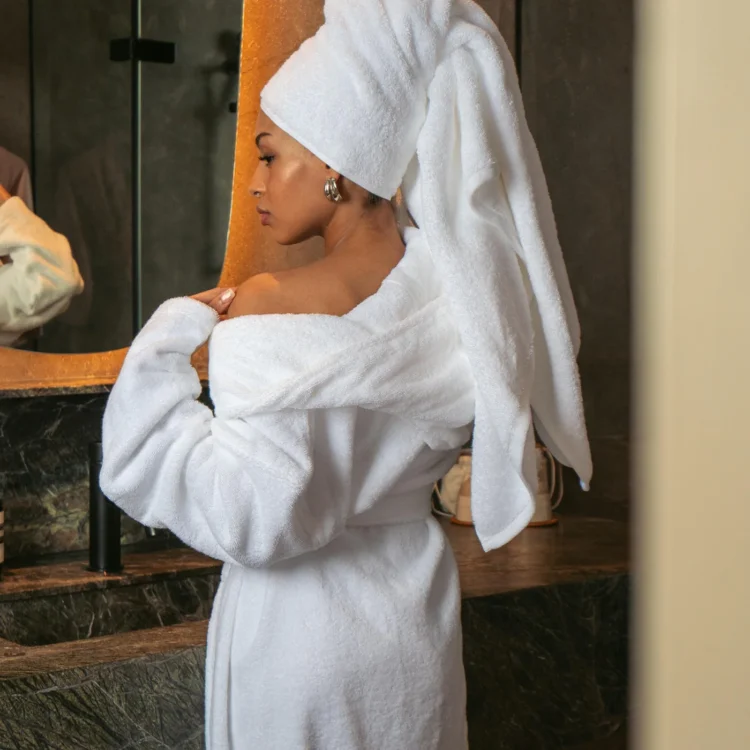
At home, bathrooms rarely get that level of choreography. They’re understaffed in terms of design intention. They become storage units for half-used bottles, towels of uncertain vintage, and a robe that migrated to the bedroom at some point and never returned. The experience of showering turns into a small logistical puzzle you solve daily without noticing. You get out of the shower, realize the towel is across the room, do an awkward cold sprint, then make peace with a damp, half-folded bathmat. It’s functional, but not exactly kind. The way hotels sidestep that is through texture and sequencing. The towel situation is always deliberate. Thick bath towels are ready for full-body dry-off, thinner ones for hands and sink duty. It’s a choreography that your nervous system understands instantly, even if you don’t consciously register it. Italic’s Serene Ultraplush bath towels behave like they were made for that choreography. They don’t audition for attention and they don’t need to “style” anything. They just have that hotel-grade density that makes getting out of the shower feel less abrupt. Their Australian Cotton hand towels are lighter and quicker to dry, which creates that secondary texture hotels rely on — the intermission fabric between the shower and the rest of the morning. The contrast is subtle, but once you experience it consistently, you start to wonder why your home bathroom ever tried to get by with a chaotic towel democracy where everything had the same weight and purpose. Robe placement is another strange source of power in hotel bathrooms. A robe hanging visibly isn’t an aesthetic gesture; it’s a behavioral one. It says: you’re not done yet. You get to ease out of this transition. You don’t have to immediately re-enter reality fully dressed. Italic’s robe works nicely in that liminal space because it operates as a buffer rather than as a fashion item. You put it on and your brain slows down while your skin finishes drying. There’s no productivity agenda attached to it. It’s not “self-care,” it’s just humane.
The part of the hotel bathroom most people underestimate is how aggressively edited it is. Counters are not platforms for brand discovery. There’s no open-air skincare museum. Everything that doesn’t need to be in your line of sight disappears into drawers or trays. The absence of visual clutter reads as sophistication, but it’s really just an absence of noise. Italic’s bathroom textiles tend to play well in that environment because they’re visually quiet — neutral colors, no branding, no clever messaging, nothing trying to narrate the experience. When objects stop yelling at you, the room becomes a place you can exist in rather than a place you have to manage.
There’s also the question of gestures — the little things hotels do that serve no practical purpose but shift the entire mood. A folded corner on a towel. A coordinating set. A robe tied loosely instead of abandoned in a laundry bin. These gestures act as proof that someone prepared the space before you entered it. Italic’s gift set taps into that logic. It feels like something pre-assembled for a future version of you, even if no one else ever sees it. At home, the mistake people make is saving these gestures for guests. The hotel bathroom logic only works when you are the guest. Once you look at it through that lens, the whole “hotel bathroom feeling” stops being mysterious. It’s not about money or design credentials. It’s about removing the tiny frictions that make mornings feel rushed and inelegant. Towels shouldn’t require a search party. Robes shouldn’t migrate to other rooms. The counter shouldn’t look like a panic dump from TSA. And there should be at least one object that feels like it didn’t need to be there but is, purely for the sake of care.
Italic fits into that ecosystem not because it chases the spa fantasy, but because its products behave appropriately in rooms where nothing is trying to be louder than anything else. There is no spectacle. The textiles do their job and disappear. You don’t have to “style” them or explain them. They let the bathroom become a set of considered gestures instead of a storage locker. Maybe that’s the real appeal of hotel bathrooms. They pre-decide the boring stuff so you can re-enter the day without feeling like you just survived something. Luxury has nothing to do with it. It’s just a bathroom that’s on your side.