Ten years ago, most women’s skincare routines consisted of a face wash and maybe a moisturizer. Today, those same women use cleansers, toners, serums, acids, retinols, SPF, and targeted treatments for specific concerns. They understand concepts like skin barrier health, the difference between hydration and moisture, and why layering products in the correct order matters. But ask them about their lip care routine and you’ll get a blank stare or a mention of whatever lip balm happens to be in their purse.
Despite lips being one of the most visible parts of your face and one of the most vulnerable to aging and environmental damage, lip care remains stuck in the early 2000s mindset of maintenance rather than treatment. We’ve collectively decided that reapplying balm sixteen times a day is a routine, when it’s actually just repeatedly addressing the symptom without ever treating the underlying problem.
The biological reality is that lips are uniquely challenging. They have no oil glands, which means they cannot self-moisturize the way every other part of your skin can. The stratum corneum—that protective outer layer—is significantly thinner on lips than on your cheeks, making them more permeable to both good and bad substances. They’re exposed to more direct environmental assault than almost any other body part because you can’t exactly keep your mouth covered all day. And they’re in constant motion—talking, eating, drinking, unconsciously licking—which means any treatment you apply gets disrupted dozens of times before it has a chance to actually work.
Then there’s the aging factor that nobody talks about. The visible signs of aging appear on lips earlier than on your cheeks, yet most people do nothing more intensive than occasional balm. Lip lines develop because the collagen structure breaks down and the vermillion border—that defined edge where your lip meets your facial skin—starts to blur. Volume decreases as fat pads shrink. The natural color fades because melanocytes decline. All of this is happening while you’re carefully applying retinol and vitamin C to your face, completely ignoring the fact that your lips are aging faster and more visibly.
The reason lip care has remained so primitive while facial care has become increasingly sophisticated is partly cultural and partly practical. Culturally, we’ve been trained to think of lips as either perfectly fine or problematically chapped, with no middle ground. The beauty industry sells us lip color and lip balm, treating lips as either decorative or damaged. The concept of preventive treatment, active ingredients, or strategic intervention doesn’t exist in mainstream lip care marketing.
Practically, lips are difficult to treat. You can’t use most active ingredients that work on facial skin because they taste terrible and you inevitably ingest some of the product. You can’t use heavy occlusive treatments during the day because they interfere with talking and eating. And unlike facial skin, where you can apply a treatment and leave it alone for hours, lip products get constantly disturbed and need to be reapplied, which makes it hard to deliver sustained active ingredient exposure.
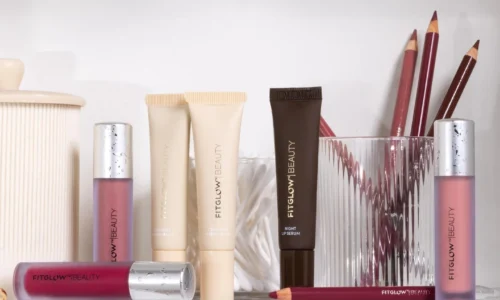
But these challenges aren’t insurmountable—they just require rethinking the approach. Nighttime treatment makes sense for lips in ways that daytime balm never will. While you sleep, you’re not talking, eating, drinking, or licking your lips. Products can actually sit undisturbed for eight hours, allowing active ingredients to penetrate and work. This is where exfoliation paired with intensive treatment creates actual results—the Healthy Lip Duo from Fitglow Beauty demonstrates this principle by combining gentle buffing with ceramide-rich overnight repair, transforming lip texture and hydration in ways that constant balm reapplication never achieves.
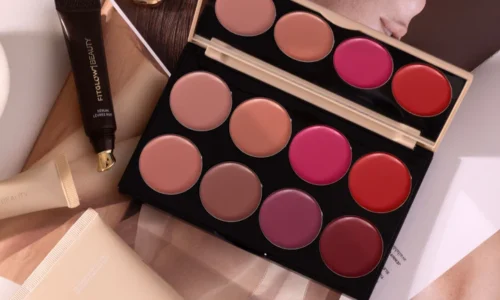
Even the tools we use for lip color reveal how far behind lip care is. Most people use lip liner solely to prevent feathering, never realizing it’s also a tool for redefining your lip line when it starts to blur with age. That blurring isn’t inevitable—it’s partly caused by sun damage and collagen loss that preventive care could minimize. A well-formulated vegan lip liner becomes corrective rather than just cosmetic, addressing an aging concern that developed because we never treated our lips with the same strategic care we gave our face. When paired with a cream lipstick palette that allows custom color mixing, you’re not just adding color—you’re creating definition that compensates for the structural changes aging brings to the lip area.
The cleansing aspect matters too, though almost nobody thinks about it. Your lips accumulate buildup throughout the day—products, food residue, environmental debris—and most people either ignore this completely or wipe it off with whatever face cleanser they’re using. But facial cleansers aren’t formulated for the unique biology of lip tissue. They’re often too harsh, stripping away the minimal natural protection lips manage to maintain. Using a gentle ceramide gel cleanser on your entire face, including lips, treats the cleansing process as an opportunity to support barrier health rather than just remove debris. The ceramides work to repair even as you cleanse, which is particularly important for lip tissue that has no oil glands to recover from barrier disruption.
Setting makeup is another overlooked opportunity for lip care. Traditional setting powders mattify by absorbing oil and moisture, which makes sense for your T-zone but works against the needs of your lip area. A bamboo hyaluronic loose setting powder that adds moisture while setting represents the kind of ingredient innovation that facial skincare embraced years ago but lip care is just beginning to explore. When you dust it over lip color to set it, you’re not drying out the already moisture-deficient tissue—you’re actually supporting hydration throughout the day.
What would it look like if we applied modern skincare thinking to lips comprehensively? We’d exfoliate regularly but gently, removing the buildup of dead cells that makes lips look textured and causes lipstick to apply unevenly. We’d use treatments with active ingredients like peptides and ceramides that actually improve the underlying structure rather than just coating the surface. We’d think about prevention—protecting from sun damage, maintaining the barrier, supporting collagen—rather than just intervention when things go wrong. We’d incorporate barrier-supporting ingredients into every step, from cleansing to color application to overnight treatment.
We’d also recognize that lip care needs to fit into real life. A comprehensive approach doesn’t mean ten separate lip products—it means choosing multifunctional products that serve both cosmetic and treatment purposes. A lip palette that nourishes while adding color. A liner that defines and prevents feathering while supporting the lip structure. An overnight treatment system that addresses both exfoliation and deep repair. A cleanser that removes without stripping. A setting powder that locks in color without desiccating tissue.
The lag between facial skincare sophistication and lip care primitiveness is strange when you consider that lips are equally visible, more delicate, and more exposed. We’ve somehow decided that the same strategic, preventive, active-ingredient approach that revolutionized facial care doesn’t apply to the part of our face we use constantly and can never hide. This isn’t inevitable—it’s just where the industry and consumer education happen to be right now. The gap exists not because lips can’t benefit from sophisticated care, but because we haven’t collectively realized yet that they should. The tools and ingredients exist—we’re just not applying them to the most visible, most vulnerable part of our face that needs them most.