
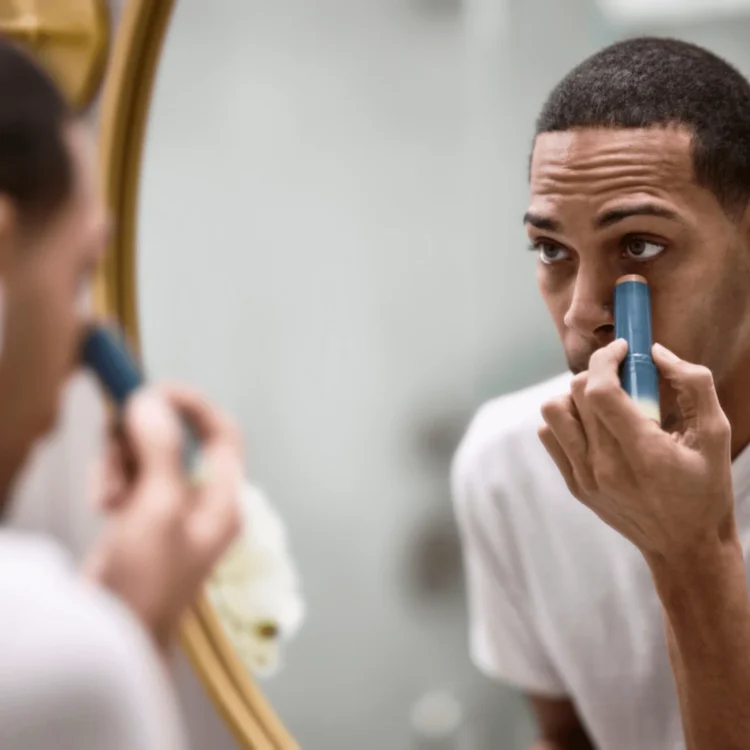
Men learn to shave from their fathers. It’s practically a rite of passage—the awkward bathroom moment where technique gets passed down, along with warnings about going against the grain and maybe a story about the first time your dad nicked himself. They learn to tie ties, polish shoes, maybe even how to iron a shirt collar if they’re lucky. But there’s a conspicuous gap in this masculine curriculum that nobody discusses.
The stuff that happens before the grooming never makes it into the lesson plan. The foundational work of making your face look like it got eight hours of sleep even when it didn’t. The management of shine that appears by midday. The coverage of the red patch that shows up exactly when you need to look composed. These skills live in a blind spot, passed over in silence from one generation to the next.
This isn’t about vanity. It’s about a practical knowledge deficit that leaves men figuring out appearance basics in their thirties, if they figure them out at all. While women receive explicit training in skincare and coverage from mothers, sisters, friends, and an entire industry built around education, men inherit exactly one message: figure it out yourself, and don’t let anyone know you’re trying.
The generational silence creates absurd situations. A man discovers at forty that the under-eye darkness he thought was genetic can be addressed in thirty seconds. Another realizes his father probably dealt with the same oily T-zone but had no framework for admitting it, let alone solving it. The tools existed—products like NuNorm’s Complete Core Collection offer everything from brow maintenance to oil control—but the permission to use them didn’t.
What’s particularly striking is how this silence perpetuates itself. Men who eventually discover solutions rarely share them, continuing the cycle. A brother doesn’t tell his younger sibling about the concealer that saved him during a stressful quarter at work. A father who uses tinted moisturizer every day never mentions it to his son, who struggles through the same issues twenty years later.
One man described finding his late father’s hidden Quick Cover stick years after he died, tucked behind shaving cream in the medicine cabinet. Never discussed. Never acknowledged. The discovery reframed his understanding of his father’s apparent effortless presentation—it wasn’t effortless at all. It was carefully maintained, but the maintenance itself had to remain invisible, unspoken, perhaps even shameful.
The inheritance tax compounds over time. Every year spent not knowing that brow thinning can be addressed, that breakouts can be covered for important meetings, that shine can be controlled before it becomes a distraction—that’s lost confidence, lost opportunities, lost comfort in your own skin. These aren’t trivial concerns. They’re the difference between spending a presentation worried about how you look versus focused on what you’re saying.
Breaking this cycle requires deliberate effort. Some fathers are beginning to shift the dynamic, keeping products like the Core Companion Bundle visible rather than hidden, treating maintenance as normal rather than exceptional. They’re having the awkward conversation about why using a brow pencil isn’t different from using hair gel, why covering a blemish before a job interview is just practical preparation.
The resistance to this knowledge transfer runs deep, rooted in outdated ideas about what men are supposed to need or admit to needing. But grooming fundamentals aren’t gendered—they’re human. Everyone benefits from knowing how to manage their appearance effectively. The only question is whether we continue to deprive half the population of basic information out of some misplaced sense of what masculinity requires.
What gets passed down from father to son shouldn’t be limited by arbitrary boundaries around what men are allowed to care about. If we can teach tie-tying and shoe-shining, we can teach coverage and oil control. The real inheritance isn’t pretending you don’t need help looking presentable. It’s knowing exactly how to handle it when you do.