Religious jewelry has clear purpose. Crosses and Stars of David, prayer beads and saint medals—these objects connect wearers to something larger than themselves, mark devotion and belonging to a tradition, create daily practice around faith. But there’s another kind of sacred object emerging, jewelry that serves similar spiritual function without invoking organized religion, that creates ritual around human connection instead of divine.
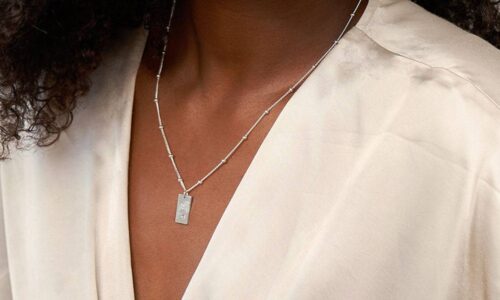
The Blossom Birth Flower and Stone Necklace from Theo & Grace becomes prayer beads for people who don’t pray in traditional ways. It’s something you touch throughout the day not for salvation but for grounding, a physical anchor that returns your attention to the fact that you’re part of a continuum that includes other people’s births and blooms. This is the same impulse that makes Catholics reach for rosaries or Muslims count prayer beads—the need for a physical object that interrupts distraction and redirects awareness toward what matters.
The difference is the object of devotion. Instead of focusing attention on God or scripture or spiritual transcendence, these pieces focus attention on human connection, on gratitude for specific people, on the ordinary miracle of relationship. This isn’t less sacred—it’s differently sacred, appropriate for people building meaning through connection rather than doctrine.
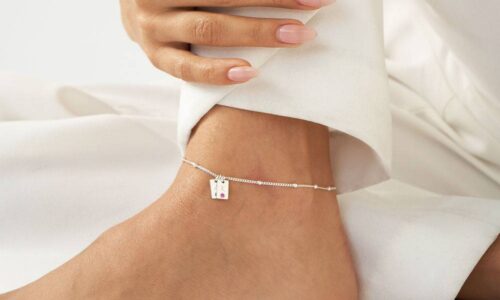
Consider the ritual of the Initial Birthstone Tag Anklet. Every time you cross your legs and notice it against your skin, there’s a small interruption, a moment where awareness shifts from whatever you were thinking about to the person that initial represents. This happens dozens of times a day, maybe hundreds, each interruption a tiny return to what matters. Over weeks and months and years, these accumulated moments create practice, the kind religions understand but secular culture rarely acknowledges—the need for repeated, physical reminders when everything else pulls us toward forgetting.
The Aurora Birthstone Huggies create their own ritual through the simple act of putting them on each morning. It’s a small but conscious decision: today I will carry this person’s stone into my day, into meetings and conversations and all the small moments that add up to a life. The daily repetition transforms the gesture from sentiment into practice, from occasional thought into consistent devotion. This is how religions work—not through occasional grand gestures but through daily small acts that accumulate meaning through repetition.
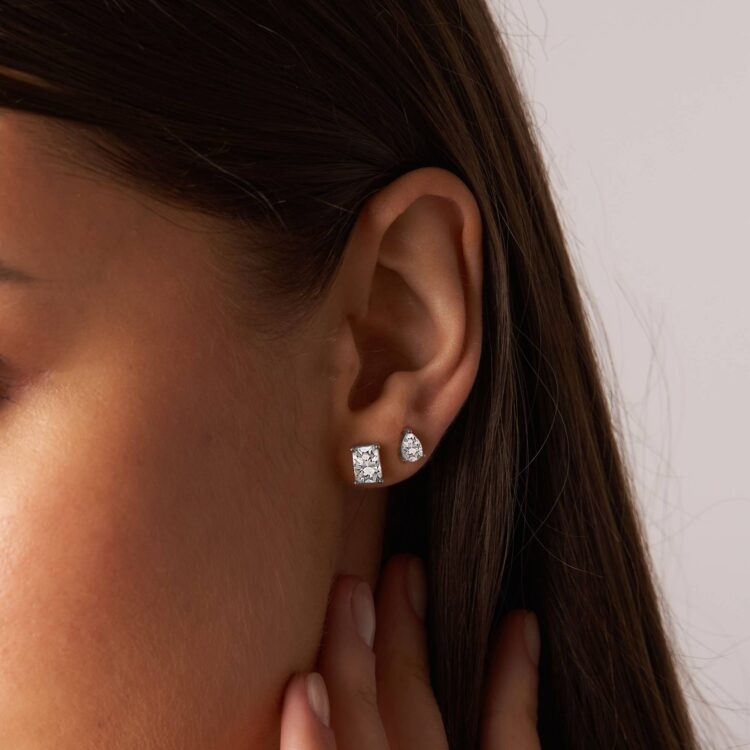
Theo & Grace’s Lorelai Rectangle Stud Earrings might seem too simple for this kind of spiritual weight, but that’s precisely the point. Devotion doesn’t require complexity or ornament. Sometimes it’s just showing up daily with the same small silver rectangles that mean I’m still here, still choosing this, still marking myself with this particular relationship. The plainness becomes the practice, the geometric simplicity a kind of meditation on consistency and presence.
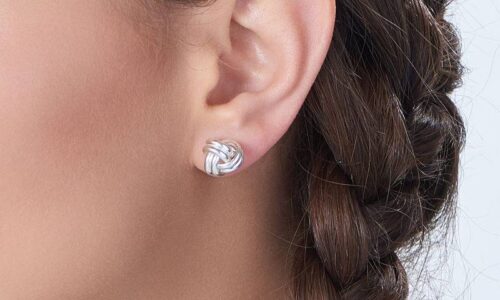
The Love Knot Earrings make the spiritual connection more explicit through their symbolism. Knots appear across cultures and centuries as markers of binding and commitment and the particular kind of strength that comes from being woven together with another person or community. Celtic knots, Chinese endless knots, the ties that bind in countless religious traditions—all pointing toward the same truth that connection creates meaning, that what we’re bound to defines us, that there’s something sacred about choosing entanglement over independence.
None of this requires belief in anything supernatural. It only requires recognition that humans need practice and ritual and physical anchors to maintain the relationships and values we claim matter most. We need to be interrupted regularly, pulled out of our heads and our to-do lists and our anxieties, reminded that we’re not alone, that we belong to people and they belong to us, that this connection is worth protecting and celebrating and returning to again and again.
This is daily devotion without deity, spiritual practice for secular people who still need the structure that religion has always provided: regular reminders of what’s sacred, physical objects that anchor abstract values, rituals that create meaning through repetition. When you touch your Blossom necklace at a difficult meeting and remember your daughter, when you feel your Initial anklet and think of your sister, when you see your Aurora huggies in a mirror and remember why you chose that particular stone—these are acts of devotion as real as any prayer.
The spiritual practice here is attention, the decision to be interrupted regularly by small metal objects that redirect awareness toward love and gratitude and belonging. These are basic human needs that secular culture often addresses through consumption rather than contemplation, buying things to feel better rather than using things to remember better. But when jewelry becomes devotional object rather than fashion accessory, it stops being about acquisition and becomes about practice, about the daily choice to mark yourself with what matters and let that marking interrupt your day in small sacred ways.
What Theo & Grace understands—what any good devotional object understands—is that we need help remembering. We need physical anchors. We need interruption. We need small rituals that bring us back, again and again, to the relationships and values that make life meaningful. This isn’t weakness—it’s wisdom about how human attention actually works, how easily we forget what matters most, how necessary it is to build structures that help us remember.